
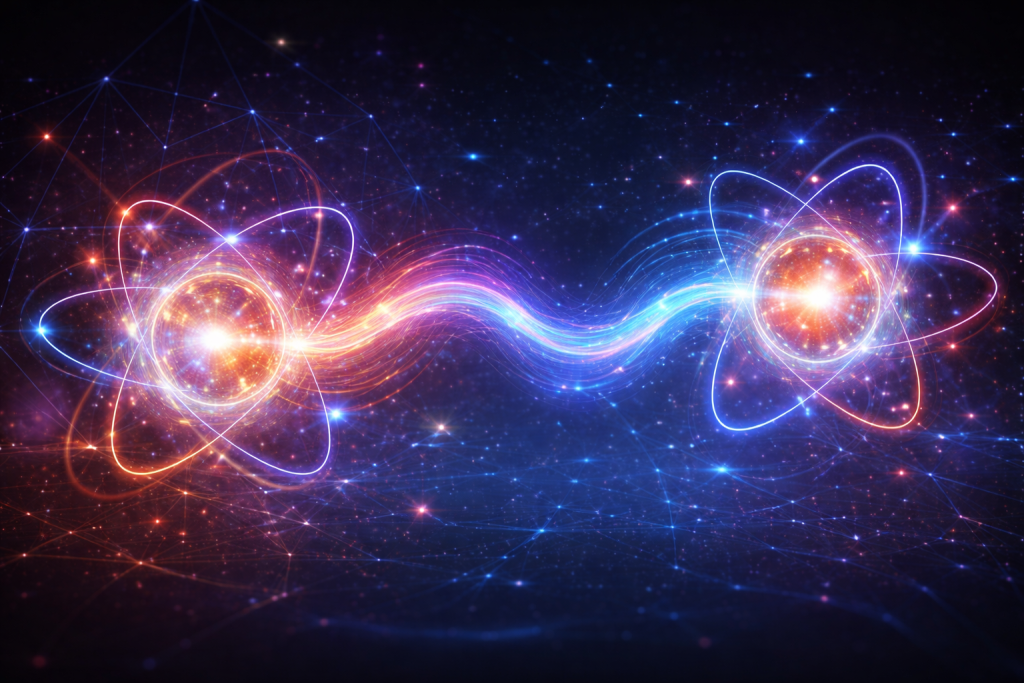
Atoms observed in two places at the same time
In a breakthrough that pushes the boundaries of our understanding of reality, physicists have demonstrated that pairs of atoms can exist in a state where they are effectively spread across two locations at once. While this may sound like science fiction, it is a direct consequence of the strange but well-established rules of quantum mechanics.
At the heart of the experiment are two key quantum principles: superposition and entanglement. Superposition allows a particle to exist in multiple states or positions simultaneously, while entanglement links two particles so that they behave as a single, unified system, no matter how far apart they are. In this case, researchers created pairs of helium atoms whose positions are not fixed. Instead, each pair shares a combined quantum state that spans two separate locations, behaving less like individual particles and more like a single, distributed object.
What makes this achievement particularly significant is that it involves matter rather than light. Similar effects have long been observed with photons, which are relatively easy to isolate and manipulate. Atoms, however, are far more complex. They have mass, interact with their surroundings, and are highly susceptible to disturbances that can destroy delicate quantum states. Successfully maintaining such behavior in atoms represents a major technical and scientific advance.
Beyond the technical feat, the experiment reinforces a profound and often counterintuitive idea: matter itself does not always occupy a single, well-defined position. Instead, it can exist as a spread-out probability distribution until it is measured. This challenges our everyday intuition about solid objects and fixed locations, offering yet another glimpse into the fundamentally probabilistic nature of the quantum world.
The implications of this work extend far beyond curiosity. In the near term, it could lead to more sensitive quantum sensors capable of measuring gravity, motion, and other physical quantities with unprecedented precision. It may also contribute to advances in quantum computing and simulation, where controlling complex quantum states is essential.
Looking further ahead, experiments like this could help address one of the deepest open questions in physics: how quantum mechanics, which governs the microscopic world, connects with gravity, which dominates at larger scales. Because atoms possess mass, placing them in quantum states opens new opportunities to explore whether gravity itself follows quantum rules.
Despite its dramatic nature, the result does not imply that atoms are duplicated or that objects can freely exist in multiple places in any practical sense. When measured, each atom is still found in a single location. What changes is the description of the system prior to measurement, which exists as a range of possibilities rather than a single outcome.
A useful way to visualize this phenomenon is to imagine not two separate particles, but a single cloud spread across space. Only when observed does this cloud resolve into a definite position. It is a subtle but powerful shift in perspective—one that continues to redefine how we think about the nature of reality.
This latest achievement is not a step toward teleportation or science-fiction scenarios, but it is a clear demonstration of how deeply non-classical the universe truly is. As researchers continue to push these effects into larger and more complex systems, we move closer to answering some of the most fundamental questions about the nature of matter, space, and existence itself.
Replies posted on Bluesky will appear here automatically.