
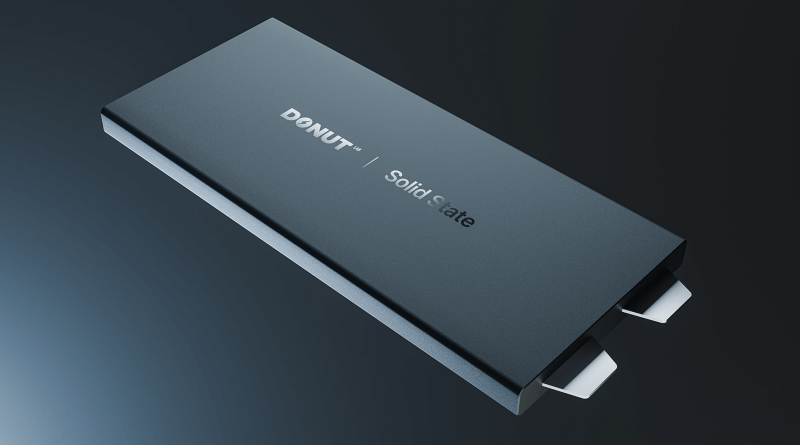
Donut Battery. Real or Fiction? First Measurement Results!
Donut Lab commissioned the internationally recognised Technology Research Centre VTT to measure the features of the first serially producible solid state battery under independent research conditions. The first test, focusing on charging speed, shows that the Donut Battery can be charged in only five minutes as previously announced.
Technology company Donut Lab has published the results of the first measurements analysing the features of its solid state battery. The tests, conducted by Technology Research Centre VTT, evaluate the Donut Battery’s charging speed and thermal behaviour during charging. It simulates a worst-case scenario, in which the battery cell lacks active temperature controls and its temperature can rise freely at extremely high charging rates.
The measurement was done using two passive cooling configurations: in the first, the cell was surrounded by two lightly compressed aluminium cooling plates, and in the other the cell was attached to only one bottom cooling plate. Recharging rates are indicated using C-rates, where 1C means that the battery is charged from empty to full in one hour (e.g. 5C = ~12 min, 11C = ~5-6 min). Traditional lithium-ion batteries typically charge at 1C to 3C with active cooling, whereas in this measurement the charging power rises to significantly higher rates without active cooling. The test started with a standard discharge capacity test at 1C, which was followed by rapid charging tests (at 5C and 11C) with both cooling configurations.
The results are in line with the five-minute charging time previously announced by the company
The measurements show that the Donut Battery can withstand astonishing charging rates even without active temperature control. Under the specified testing conditions, the cell was successfully charged at 5C for over nine minutes. At this charging power, the battery cell reached an 80% state of charge in about 9.5 minutes and a full 100% state of charge in just over 12 minutes. When discharged after charging, 100% of the charged capacity was available from the cell.
The battery cell was then recharged rapidly at the extreme speed of 11C. Charging from 0 to 80% was achieved in 4.5 minutes and a full 100% state of charge in just over seven minutes. When discharged after a full charge, 98.4 to 99.6% of the battery capacity was available for use.
Even though the testing conditions did not directly simulate cell behaviour in a battery pack, the measurement demonstrates the benefits of the Donut Battery as part of a pack as well. The battery cell does not require any particular compressive force and works well with passive cooling, which simplifies the battery pack architecture.
“Unlike other solid state batteries requiring high compressive pressures and undergoing volume changes of up to 15-20% during recharging cycles, the Donut Battery does not require special compression or more extensive cooling. This greatly simplifies the structure of battery packs and enables solutions that are cost-efficient, powerful, and better than traditional lithium-ion batteries in terms of energy and power density”, says Donut Lab CTO Ville Piippo.
The measurement report can be viewed in full on the I Donut Believe website.
Hi, this is a comment.
To get started with moderating, editing, and deleting comments, please visit the Comments screen in the dashboard.
Commenter avatars come from Gravatar.