
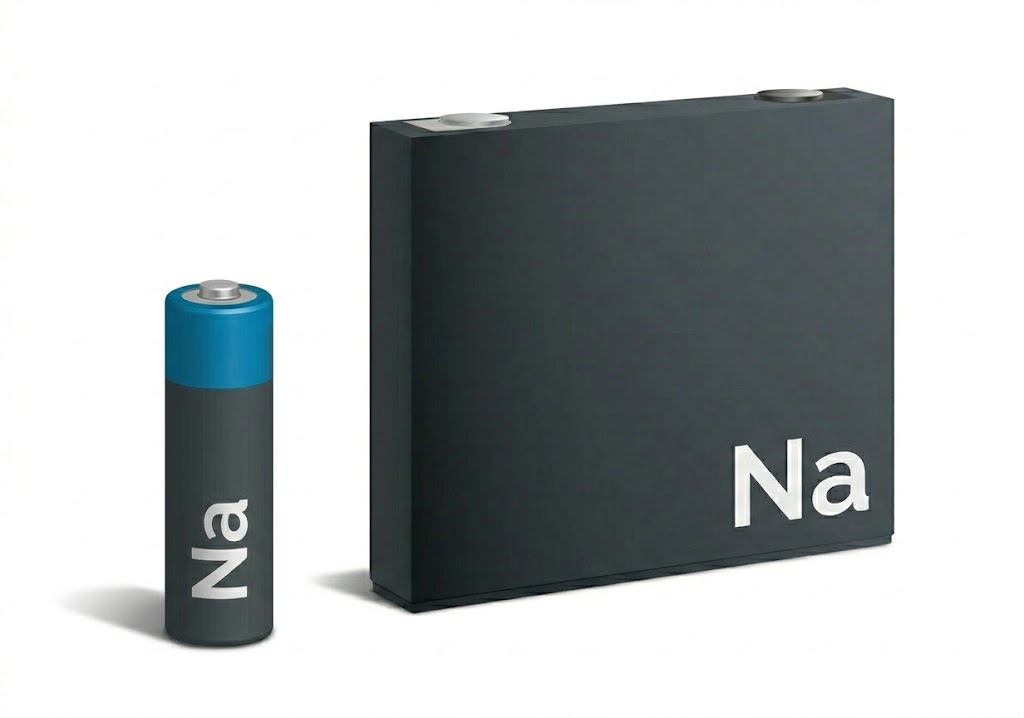
Forget Lithium. Sodium Just Got Serious.
A new study published in Nature may have quietly solved one of the biggest headaches in battery research. Scientists at Shanghai Jiao Tong University (SJTU) and Fudan University — both in Shanghai, backed by China’s National Natural Science Foundation — have cracked a long-standing voltage problem with sodium-sulfur batteries. It’s a technology that’s been tantalizing researchers for years because of how cheap and abundant sodium is compared to lithium, but has never quite delivered on its promise.
The core breakthrough is an anode-free design. Traditional batteries have a metal slab (the anode) pre-built into the negative side, which requires loading in a lot of sodium upfront — making the battery bulky, reactive, and dangerously flammable. The new design skips that entirely. Instead, the negative electrode forms naturally during the battery’s first charge cycle, using sodium pulled from the electrolyte itself. Less reactive metal, less dead weight, more energy density, longer lifespan. It’s an elegant fix.
But the number that really jumps out is the projected production cost: $5.03 per kilowatt-hour. For context, today’s lithium-ion batteries — the kind powering your Tesla, your MacBook, your phone — cost anywhere from $40 to $140 per kilowatt-hour to produce. That’s not a marginal improvement; it’s a potential sea change for the energy storage industry.
The researchers are clear that this won’t be replacing the battery in your iPhone anytime soon. The real target is large-scale energy storage — think grid-level systems backing solar farms, where cost-per-kilowatt-hour matters enormously and flammability risks are a serious engineering concern today.
Sodium-sulfur tech has been a “promising but not quite there” story for a long time. This study, if it scales, might finally be the chapter where it arrives.
Replies posted on Bluesky will appear here automatically.