
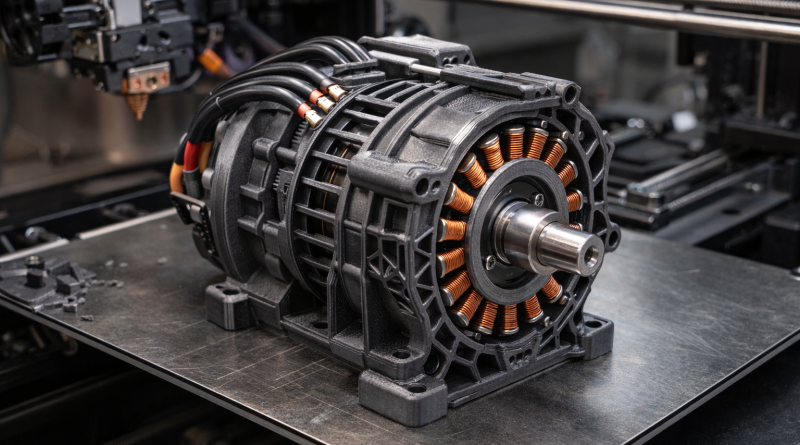
MIT Researchers Unveil World’s First Fully 3D-Printed Electric Motor
CAMBRIDGE, MA — In a breakthrough that could redefine how we manufacture complex machinery, researchers at the Massachusetts Institute of Technology (MIT) have developed a method to 3D-print a fully functional electric motor in a single process.
While 3D printing has long been used for plastic prototypes and simple metal parts, high-performance “active” devices like motors have traditionally required labor-intensive manual assembly of magnets, copper coils, and steel cores. The new study, published in the journal Virtual and Physical Prototyping, describes a custom-built 3D printing platform that can handle five distinct functional materials simultaneously, effectively “growing” a motor from scratch.
One Machine, Five Materials
The research team, led by Luis Fernando Velásquez-García, modified a commercial multi-material printer to become “multi-modal.” Their system can swap between four different tools to process materials in three different forms: filaments, inks, and pellets.
To create the motor, the printer deposited a complex “recipe” of materials:
- Conductive Inks: To form the electrical coils (solenoids).
- Hard Magnetic Pellets: To create the permanent magnets.
- Soft Magnetic Composites: To focus the magnetic fields.
- Flexible Filaments: To create a built-in plastic spring.
- Rigid Dielectrics: To provide the structural body and electrical insulation.
“This milestone advances multi-material 3D printing towards implementing customized, low-waste, and low-cost functional hardware,” the researchers noted in the paper.
Performance and Potential
The proof-of-concept device is a linear motor—a type of actuator that moves back and forth rather than spinning. Despite being printed as a single integrated structure, the motor achieved a displacement of 318 micrometers. The only step required after the printing finished was the magnetization of the “hard” magnetic components, a quick post-processing task.
Perhaps most striking is the cost. While traditional electric motors can be expensive due to the precision machining and specialized materials required, the researchers estimate that these 3D-printed versions could cost as little as 50 cents each in materials.
Why It Matters
The ability to print “ready-to-use” electronics and motors has massive implications for several industries:
- Space Exploration: Astronauts could print replacement parts or custom robots on-demand without waiting for supply shipments from Earth.
- Rapid Prototyping: Engineers can now test new motor designs in days rather than months.
- Education and Small Business: The system was built using under $4,000 in parts, potentially “democratizing” the manufacturing of electrical machines for schools and startups.
While the current motor is small and less powerful than industrial-grade versions, the MIT team believes this is just the beginning. The research demonstrates that the gap between “printing a shape” and “printing a machine” has finally been closed.